
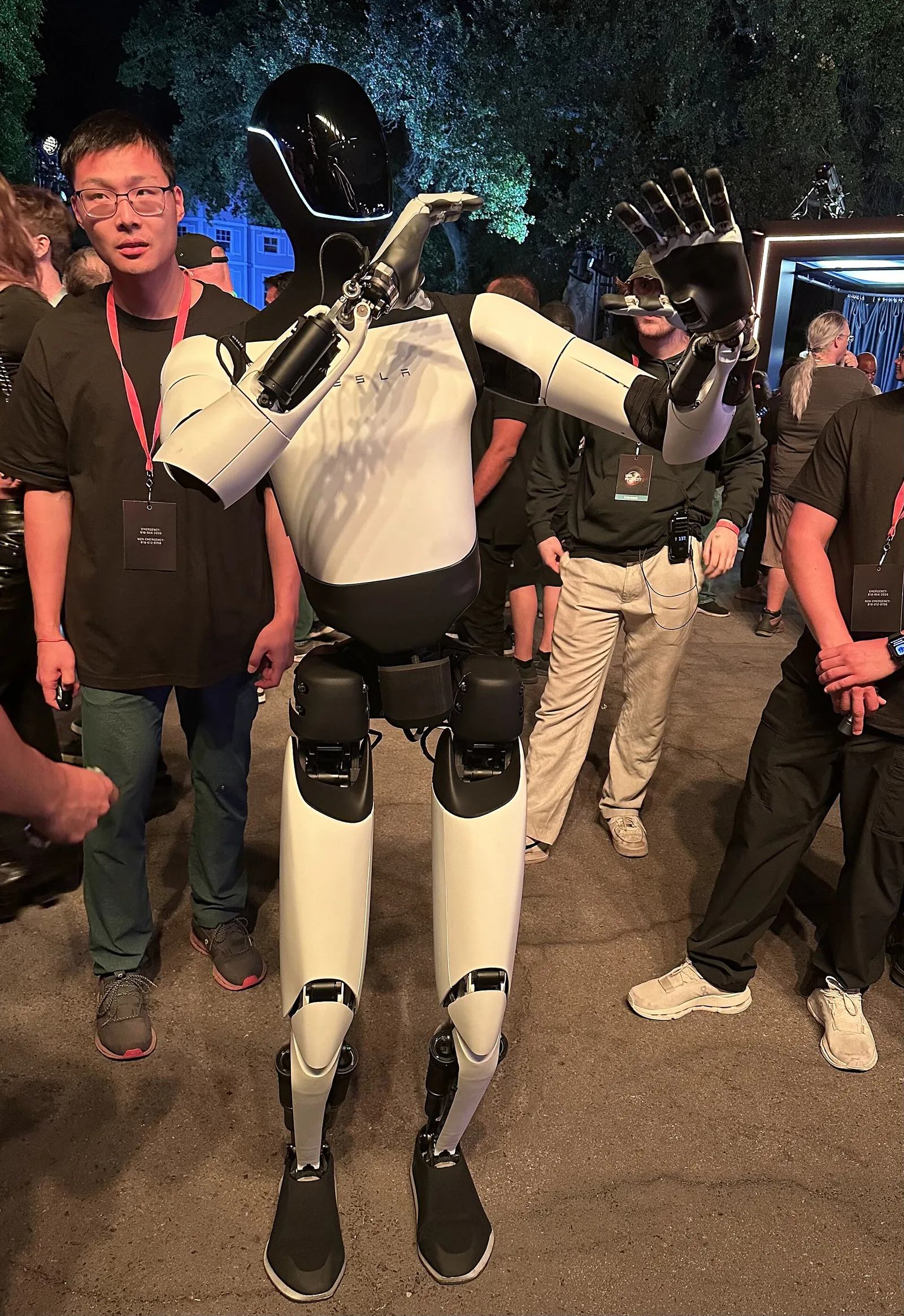
Image: Steve Jurvetson / CC BY 2.0 (Wikimedia Commons)

In short: Humanoid robots are arriving more slowly than promised. Tesla has started early Optimus production in Fremont but expects deliveries to outside customers only around the end of 2027; the hands remain the biggest problem. Boston Dynamics has been building the product version of Atlas since January 2026, with all 2026 units going to Hyundai and Google DeepMind. XPeng plans series production of IRON by the end of 2026 and a European launch in 2027. A household robot remains a thing of the future.
Tesla Optimus
On its 21 October 2026 earnings call, Tesla said early production has started on a Fremont line designed for about one million robots a year. Reaching that rate will take at least a year. Open issues include the hands, custom gears, the AI architecture and durability. Tesla plans an "Optimus Academy" with 10,000 to 20,000 robots practising tasks, and the AI5 chip from around April 2027. Musk's timelines have often slipped, so treat these dates as announcements, not guarantees.
Boston Dynamics Atlas
Unveiled at CES in January 2026, the electric Atlas went straight into production. All 2026 units are committed to Hyundai's RMAC and Google DeepMind; more customers follow in early 2027. Atlas swaps its own batteries. Reuters reports Hyundai plans to deploy humanoids in a US plant from 2028.

XPeng IRON
Presented in Paris on 12 October 2026: mass production by end of 2026, deliveries from the first half of 2027 and European marketing from the second half. IRON first targets stores and malls and speaks Chinese, English and German.
| Robot | Maker | Status | Target |
|---|---|---|---|
| Optimus | Tesla | early production, deliveries late 2027 | industry |
| Atlas | Boston Dynamics | in production, sold out for 2026 | industry |
| IRON | XPeng | series production planned by end of 2026 | retail, later home |
| NEO | 1X | pre-order, about $20,000 | home |
Why it is hard
Humanoids fit human environments, but balance, delicate hands and AI that understands objects are difficult, and robots lack the huge real-world data sets cars have. Safety rules such as the EU Machinery Regulation and the AI Act apply, and home robots with cameras raise privacy questions. For now, robot vacuums are more mature, see our robot vacuum guide and the AI autumn 2026 overview. More in the Robotics section.
Sources